How Do Manifold Blocks Reduce Leak Points in Hydraulic Systems?
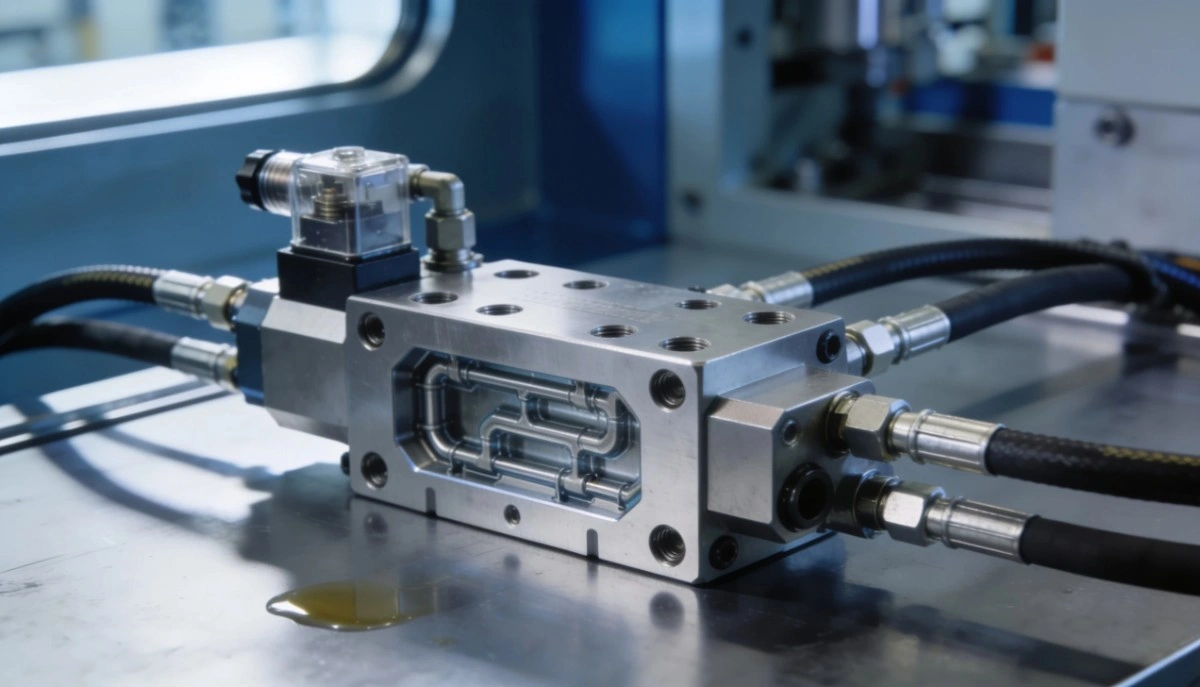
Why Indian industries are ditching external pipe connections — and building tighter, cleaner hydraulic circuits.
Nobody notices the first drop. Then the puddle grows. Pressure falls. The machine slows. Maintenance comes. And somewhere, buried inside a web of fittings and elbows, a threaded joint has given up.
This is not a rare scenario. Walk through any hydraulic machinery bay in India and you will see it. Fluid stains on the floor. Rags wrapped around suspect joints. Pressure gauges that drift without warning.
Most of these leaks share one root cause — too many connection points. Every elbow, tee, and threaded fitting is a seal waiting to fail. The fix is not better maintenance. It is fewer joints. That is exactly what a hydraulic manifold block delivers.
Common Challenges with Conventional Hydraulic Plumbing
Piped hydraulic circuits are common because they are familiar. But familiarity hides the problems:
- Each pipe-to-pipe joint is a potential leak — and a typical sub-circuit may have 20 or more
- Vibration from pumps and actuators gradually loosens threaded fittings
- Pressure cycles cause micro-movement at joints — seals degrade faster than expected
- Fault-finding through a pipe network is slow and often requires partial disassembly
- External plumbing increases the panel footprint — a real problem in compact power units
For engineers sourcing Hydraulic blocks online or comparing domestic suppliers, these failure patterns come up again and again. The answer is circuit consolidation — not more pipe.
TRIVIA: The term 'manifold' traces back to Old English meaning 'many folds' or 'many openings' — exactly what the block replaces: dozens of individual connections folded into one solid component.
What Exactly Is a Hydraulic Manifold Block?
A hydraulic manifold block is a solid machined component — mild steel, ductile iron, or aluminium — with internal flow passages drilled through it. These passages carry pressurised fluid between valves, pumps, cylinders, and actuators. No pipe. No external fittings between those points. Just clean internal bores.
N.T. Associates, a recognised Hydraulic Manifold Block Manufacturer in India based in Ghaziabad, produces these blocks on CNC machining centres. Each unit is drilled to precise bore dimensions, surface-finished for consistent port sealing, and pressure-tested before dispatch.
Three Common Manifold Types
- Monoblock — single-piece, high-rigidity, suited for high-pressure fixed circuits
- Modular — stackable sections, allows adding or removing circuit stages
- Cartridge — valve cavities machined directly in the block, near-zero external valves
DID YOU KNOW: A single CNC-machined manifold can replace up to 30 individual pipe fittings. Assembly time on a hydraulic power pack drops sharply — and so does the leak risk.
How Manifold Blocks Cut Leak Points
The logic is direct. Joints leak. Hydraulic blocks remove joints. Every internal flow passage replaces what would otherwise be two pipe ends, a fitting body, and a seal. Remove the fitting, remove the failure point.
Consider a real-world example. A directional valve sub-circuit with six valves, built conventionally, might need 24 external pipe connections. The same circuit on a manifold uses four inlet and outlet ports — the rest are internal.
- Internal drillings are machined — no seals, no joints, no movement under pressure
- ORFS (O-ring face seal) port standards used on manifolds give near-zero-leak external interfaces
- Valve mounting pads are integral to the block — no separate valve bodies to seal
- Fewer external components also means less vibration-transmitted stress on connections
The result: leak-point reduction of 80 to 85 percent is realistic when switching from conventional piping to well-designed hydraulic blocks layout.
Conventional Piping vs. Hydraulic Manifold Block
| Parameter | Conventional Piping | Manifold Block | Outcome |
|---|---|---|---|
| Leak Points | 15 – 30+ joints | 2 – 4 ports | Up to 85% fewer |
| Assembly Time | High | Low | Faster build |
| Maintenance | Complex | Port-by-port | Less downtime |
| Footprint | Large | Compact block | Space saving |
| Pressure Rating | Moderate | Up to 350+ bar | Heavy-duty ready |
| Customisation | Limited | CNC to spec | System-specific |
Key Features That Matter on the Shop Floor
Here are some key Features That Matters.
Pressure and Structural Strength
- Machined from solid billet — no weld lines, no weak zones
- Handles over 350 bar in heavy-duty configurations
- Fatigue-resistant — important on machines with high cycle rates
Customisation Options
- Hydraulic manifold block designs can be tailored to your valve arrangement and port sizes
- CETOP 3 and CETOP 5 valve mounting patterns available as standard
- Multi-station layouts possible — multiple circuits in one block
Maintenance on Site
- Each port is accessible individually — no dismantling surrounding pipes to reach one valve
- Fault isolation is fast: test port by port, not pipe by pipe
- Valve replacement on a manifold does not disturb adjacent circuits
FACT: Hydraulic fluid loss through leaks costs Indian manufacturing plants significant production hours every year. Manifold-based circuit design addresses this at the source — not through maintenance patches.
Where These Blocks Are Used in India
The shift to hydraulic blocks is visible across sectors:
- Machine tool builders use manifold-based power packs for clamping and indexing
- Press and forging equipment runs cyclic high-pressure loads — manifolds handle this better than pipe
- Injection moulding machines rely on integrated manifolds for clamp and ejection circuits
- Agricultural and construction OEMs reduce under-hood plumbing with compact manifold blocks
- Material handling equipment — lifts, hoists, conveyors — uses manifolds where space is tight
Teams searching for hydraulic blocks near me or a reliable Hydraulic Manifold Supplier in Ghaziabad will find that N.T. Associates maintain ready stock alongside custom manufacturing — no long lead times for standard configurations.
Why N.T. Associates for Hydraulic Manifold Blocks
N.T. Associates is a CNC-based Hydraulic Manifold Block Manufacturer in India with a manufacturing base in Ghaziabad. Their range covers monoblock, modular, and cartridge types — supplied to OEMs, system integrators, and industrial maintenance teams across the country.
- CNC machining on every unit — dimensional accuracy and surface finish are consistent
- In-house design support — clients get technical input, not just a catalogue
- Stock availability — no waiting weeks for standard block configurations
- Supplying Hydraulic Manifolds at Best Price in India without cutting corners on material or machining quality
- Easy to source as hydraulic blocks online — specifications and enquiry available at nthydraulic.com
The hydraulic manifold block in India market has grown sharply as OEMs demand tighter builds. N.T. Associates sits at the centre of that demand — engineering support plus reliable supply, not just components off a shelf.
NTH
‘N.T. Associates has spent over a decade building one thing — hydraulic systems that actually hold up. Hydraulic hosepipes, precision components, motors, vane pumps, power packs — everything we make is built around real application demands, not just technical specs.
We don't work through catalogues or assumptions. Every customer conversation starts with understanding the operation — what it handles, where it runs, and what failure costs. That's how we design solutions that fit, not just products that ship.
Manufacturing plants, heavy equipment operators, and process industries across India rely on us because our products are consistent and our support is direct.
Tell us what your system needs. We'll build it.’
Conclusion
Leaks are a design problem dressed up as a maintenance problem. Conventional plumbing builds risk into every joint. Manifold blocks take those joints away.
Fewer connections. Fewer failure points. Cleaner systems. Less downtime. For anyone evaluating a hydraulic manifold block in India — whether for a new machine build or a system upgrade — the engineering case is straightforward. The block is not a premium add-on. It is the smarter default.
Looking to cut leak points in your next hydraulic build? Talk to N.T. Associates — visit nthydraulic.com and get the right hydraulic manifold block for your system today.
It is a machined block with internal flow passages that connects valves, pumps, and actuators — replacing external pipe fittings and cutting leak points significantly.
Every internal passage replaces a pipe joint. Fewer joints mean fewer seals. Fewer seals mean fewer failure points. That is the entire leak-reduction logic in practice.
Machine tool, press, forging, injection moulding, agriculture, and material handling industries all use them — anywhere compact, leak-free hydraulic circuits matter on the shop floor.
Yes. N.T. Associates machines blocks to your valve arrangement, port sizes, and pressure requirements. CETOP 3 and CETOP 5 mounting patterns are available as standard options.
Not with the right supplier. N.T. Associates maintains ready stock and custom manufacturing from Ghaziabad — standard configurations ship without long lead times across India.
Mild steel, ductile iron, and aluminium are the common choices. Material selection depends on operating pressure, fluid compatibility, and whether the application is mobile or stationary.