
How to Select the Right Hydraulic Hose and Fittings for Your Industry
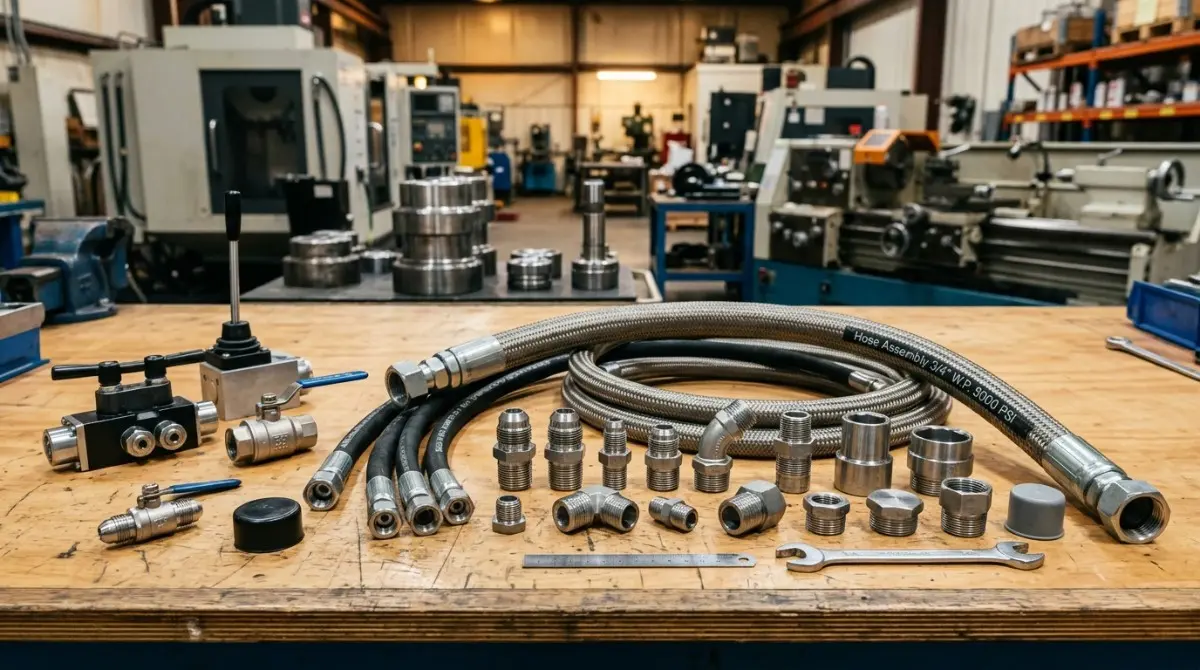
The hydraulic system of your machinery is the backbone of your machinery, whether it is a construction fleet, a manufacturing plant, or an agricultural operation. The core of that system is something that is frequently ignored until it breaks down the hose and fitting assembly.
When choosing the correct hydraulic hose, it is not merely a matter of picking out what fits. It is of aligning pressure ratings, fluid compatibility, bend radius, temperature range, and end-use environment – simultaneously. Make a mistake and you are talking about leaks, disastrous failures and expensive downtime. Get it right, and your machinery runs efficiently for years.
This manual takes you through all you need to know to make the correct decision – authored by engineers and industry practitioners who deal with these bits on a daily basis.
Why the Right Hose Selection Matters More Than You Think
The hydraulic hose is not a simple tube that has fluid. It is a highly precise part that should be.
- Resist pressures in the workplace that may be above 350 bar (5,000 PSI).
- Handle continuous flexing and vibration without fatigue.
- Face chemical attack of hydrostatic oils, water glycol, and synthetic fluids.
- Operate consistently in temperatures ranging between -40 C to +150 C.
- Adhere to industry safety requirements (SAE, ISO, EN, DIN).
Any of these factors being neglected results in an early hose failure – and in industrial applications, early failure hardly occurs at the opportune moment.
The S.T.A.M.P.E.D. Method: Your Selection Framework
Industry professionals use a widely trusted 7-point checklist known as S.T.A.M.P.E.D. before specifying any hose assembly. Here is what it means:
| Letter | Stands For | What to Consider |
|---|---|---|
| S | Size | Internal diameter (ID) and outside diameter (OD) for correct flow rate |
| T | Temperature | Minimum and maximum temperature of fluid and surrounding environment |
| A | Application | Where the hose will be used (mobile, stationary, subsea, etc.) |
| M | Material | Hose inner tube, reinforcement, and cover compatibility with fluid |
| P | Pressure | Working pressure, surge pressure, and minimum burst pressure rating |
| E | Ends/Fittings | Thread type, end configuration, and fitting material |
| D | Delivery | Lead times, availability, and supplier reliability |
This framework takes the guesswork out of hose selection and ensures that every critical variable is accounted for before a hose is ever installed.
Understanding Hose Construction: What Is Inside Matters
The first thing to do before selecting a hose is to know how it is constructed so that you can fit it for the appropriate usage.
- Inner Tube The nearest layer containing the fluid. It should be able to work with the type of hydraulic fluid being used (mineral oil, water-based fluids, bio-fluids, etc.). Inner tubes are mostly manufactured using synthetic rubber (NBR, EPDM) or thermoplastic.
- Reinforcement Layer It is what gives a hose its pressure rating. It can be:
- Wire braid – medium pressure, lowflex.
- Wire spiral – high-pressure, high-impact design.
- Textile braid – in low-pressure return lines.
- Outer Cover Eliminates abrasion, UV, ozone and environmental damage of the hose. The rubber covers are standard; polyurethane covers are employed in harsh outdoor or mobile conditions.
Choosing the Right Hydraulic Fittings
Hydraulic fittings are the connectors that join hoses to pumps, cylinders, valves, and other components. A perfect hose paired with the wrong fitting is a recipe for leaks.
Key Fitting Standards Used in India
| Standard | Common Usage |
|---|---|
| BSP (British Standard Pipe) | Most common in Indian industrial machinery |
| NPT (National Pipe Thread) | Used in American-origin equipment |
| JIC (Joint Industry Council) | 37° flare, common in mobile hydraulics |
| DIN (German Standard) | Used in European-designed systems |
| SAE Flange | High-pressure applications, easy to assemble |
Fitting Material Selection
- Carbon Steel – General purpose, economical, most mineral oil systems.
- Stainless Steel — Non-corrosive, can be used in washdown or marine environments.
- Brass – Instrumentation and low-pressure lines.
Tip: It is always advisable to use the appropriate material to fit the operating environment. Stainless steel fittings used in industries experiencing high chemical or coastal conditions have a tremendous life span compared to their carbon steel counterparts.
Industry-Wise Selection Guide
Different industries have different demands. Here is a quick reference:
| Industry | Typical Pressure Range | Recommended Hose Type | Key Concern |
|---|---|---|---|
| Construction & Mining | 250–450 bar | Wire Spiral (R12/R13) | Abrasion resistance |
| Agriculture | 100–250 bar | Wire Braid (R1/R2) | Flexibility, UV resistance |
| Manufacturing | 150–350 bar | Wire Braid / Spiral | Temperature cycling |
| Steel & Foundry | 200–400 bar | High-temp spiral hose | Heat resistance |
| Automotive Assembly | 100–250 bar | Thermoplastic | Clean-room compatibility |
Where to Source: Hydraulic Hose Pipe Suppliers in Ghaziabad
Ghaziabad has become one of the biggest industrial centres and has developed a large localisation of hydraulic component manufacturers and traders. When sourcing locally, it is important to be close to a reliable supplier, in particular when you require an emergency replacement or a bespoke assembly at short notice.
In considering suppliers of Hydraulic Hoses and Fittings in this area, consider:
- On-site fabrication capacity – Are they able to create custom hose assemblies locally?
- Pressure testing equipment - Do they test assemblies prior to shipment?
- Brand affiliation — Do they have a licensed dealer of reputable brands such as Parker, Eaton, Rexroth or Yuken?
- Technical service – Does their staff know how to make the correct choice of hose for your use?
- Inventory penetration – Are they carrying standard sizes and fittings or do you have to wait weeks to have them delivered?
N.T. Associates is one such company that fits all these features, as it is not only a supplier of hydraulic hose pipes but also a company that offers a complete hydraulic system solution under one roof.
5 Common Mistakes to Avoid When Selecting Hydraulic Hoses
- Neglecting Pressure Spikes: Systems hardly run at steady-state pressure. The surge pressures may be 2-3 times the working pressure. When using a hose, make sure it is much higher than your normal operating pressure.
- Bending the Radius: There is a minimum bend radius to every hose. Applying more than it – even half its value – results in fatigue of the internal wires and a reduction in the hose life by many times.
- Selecting Fittings by Cost Only: An inexpensive fitting on a high-pressure line is unsafe. Align the compatibility with the system pressure, but not the budget.
- Ignoring Fluid Compatibility: Not all inner tube materials are compatible with all hydraulic fluids. By applying a mineral oil hose in a water glycol system, premature tube degradation occurs.
- Skipping Hose Assembly Testing: Assembled hoses should be pressure tested at 1.5x working pressure before installation. This step alone eliminates most field failures.
Buying Online vs. Local Sourcing — What Works Better?
Most plant engineers now tend to buy hydraulic hose assemblies online for convenience; others tend to go to a local dealer and view them firsthand and get the hose custom-built more quickly.
Here is an honest comparison:
| Factor | Online | Local Dealer |
|---|---|---|
| Convenience | High | Medium |
| Custom lengths | Limited | Yes, on-site |
| Technical advice | Chat/email | Face-to-face |
| Emergency supply | Slower | Same day possible |
| Price | Competitive | Negotiable |
In non-critical applications with a standard size, it is fine to order hydraulic hose online. In the case of high-pressure, custom or safety-critical lines, it is highly advisable to deal with a local supplier with knowledge.
Bulk Procurement: What to Know Before You Order
If your operation is in need of bulk hydraulic hoses – for fleet maintenance, OEM manufacturing or a large one-off project – there are a few things to keep in mind when placing an order:
- Standardize hose specifications throughout your fleet whenever possible to simplify your SKU numbers.
- Ask for batch certification – this includes MTRs (Material test reports) and proof of pressure testing for each lot.
- Negotiate Blanket Purchase Orders: Secure a price with your chosen vendor that will be locked in. Also, you may want to look into preferred vendor status.
- Ensure correct storage – hoses should be stored flat, in a cool, dry location that isn’t exposed to ozone or UV rays, with their end caps installed.
NTH has a focus on this integrated thought process with each of our hydraulic systems and fluid power solutions.
Related Blog You Might Be Interested In:
Complete Guide to Hydraulic Hose Pipes for Industrial & Bulk Buyers
Are You A Local Buyer?
When searching on google for “hydraulic fittings near me” or considering a hydraulic hose supplier in Ghaziabad that you can trust, having the right partner is paramount. Search for suppliers that combine technical understanding with product availability – not just a supplier, but an application resource.
For any industry throughout India seeking a 'Hydraulic Hose near me' search and requiring immediate/bulk supply, relying on a proven provider such as N.T. Associates will result in a properly specified, application-suitable solution – not just an off-the-shelf component.
About Us
‘As an experienced company with a global reputation as a leader in providing advanced hydraulic solutions for modern manufacturing purposes, N.T. Associates has built its reputation through dedication to quality and innovation, which is reflected in our ability to supply reputable products and services in diverse industries, including those listed previously. Our many years of experience in providing specialty hydraulic hose pipes and precision-engineered components give us confidence that all our products will comply with the most stringent performance standards. N.T. Associates is a specialist in providing comprehensive solutions for hydraulic systems, including hydraulic pipes, hydraulic motors, hydraulic vane pumps, hydraulic power packs, etc. Our experience comes from working with customers—a step that allows us to better determine what our customers need and to provide them with customized solutions to improve their everyday productivity and efficiency levels. If you are seeking hydraulic hose pipes, hydraulic motors, hydraulic vane pumps, hydraulic power packs, or any other related hydraulic equipment to support your operations and achieve your business goals, N.T. Associates can provide that solution.’
Conclusion
Choosing the correct hydraulic hose and fittings is as much an art form as it is an engineering process. The S.T.A.M.P.E.D. Approach, knowledge of how hoses are manufactured and what to look for in fittings, and dealing with a trusted supplier – these are the fundamental elements for a hydraulic system that works both safely and reliably. Regardless of whether you are simply changing a single hose in the workshop or trying to implement an entire purchasing programme facility-wide, spending an extra amount of time to ensure you have the correct product to do the job correctly will lead to decreased downtime, increased safety, and extended equipment life.
For high-performance hydraulic systems and fluid power solutions, NTH is your best partner—Connect with us now!
The S.T.A.M.P.E.D. method is an industry-standard checklist used to ensure the right hose is selected. It stands for Size, Temperature, Application, Material, Pressure, Ends/Fittings, and Delivery. Using this framework prevents selection errors that lead to system failure.
Not all rubber or thermoplastic materials can handle every fluid. Using a hose incompatible with your hydraulic fluid (e.g., using a mineral oil hose for water glycol) will cause the inner tube to degrade, leading to leaks, contamination, and total system failure.
It depends on your pressure and flexibility needs. Wire braid is typically used for medium-pressure applications and offers better flexibility. Wire spiral is designed for high-pressure, high-impact environments (like mining or construction) where the hose must withstand frequent pressure surges without fatigue.
Local suppliers like NTH offer on-site fabrication for custom lengths, immediate emergency replacements, and face-to-face technical advice. They can also perform pressure testing before delivery, which is often difficult to verify when buying standard parts online.
When ordering in bulk, always request batch certifications, including Material Test Reports (MTRs) and pressure test certificates for each lot. These documents verify that the hoses meet required safety standards and can handle the specified working pressures.
Hoses should be stored horizontally (flat) in a cool, dry area. It is critical to keep them away from UV light and ozone, which can crack the outer cover. Additionally, keep end caps fitted at all times to prevent dust and moisture from contaminating the inner tube.