

Choosing the Right Hydraulic Manifold Manufacturer
A ground-level buyer's guide — for engineers, dealers, and procurement teams who've been burned by the wrong supplier before.
Let me tell you something that took a few bad purchases to learn. A hydraulic manifold isn't the kind of component you want to think about after you've installed it. When it works, you forget it's there. When it doesn't — a leaking port, a mismachined gallery, a block that arrived out of spec — the downtime hits fast and the blame lands on whoever signed the purchase order.
I've spoken to enough maintenance heads and OEM engineers across India to know the real frustration isn't the price. It's being bought from a Hydraulic Manifold Block Manufacturer in India who looked credible on paper but couldn't back it up with consistent quality, proper documentation, or honest lead times. That's the gap this guide tries to fill.
Top Features at a Glance
Cut through the catalogue language. Here's what actually matters when you're evaluating a manifold block:
- Material grade — EN-8 is fine for light-duty work; if you're running above 200 bar, insist on EN-24 or better
- Port-face flatness within ±0.02 mm — anything looser and you'll fight leaks at the valve seat
- 100% hydrostatic testing at 1.5× working pressure, not random batch sampling
- Hydraulic manifolds and plates compatibility — needed if your circuit uses sub-plate or modular valve grouping
- Surface finish Ra ≤ 0.8 µm on valve faces — go to ≤ 0.4 µm for anything high-pressure
- Mill certificates on billet material — traceable, not just stated
- Lead time commitment in writing — verbal promises don't count when your assembly line is waiting
Benefits — Why a Dedicated Manifold Matters
I know the argument against manifold blocks. More expensive upfront. Feels like overkill for a smaller circuit. The fittings and hose approach seems simpler.
Except it isn't. A properly machined Hydraulic Manifold Block pulls together what would otherwise be 40, 50, sometimes 80 individual connections into a single precision body. Every joint you eliminate is a potential leak you've engineered out of existence. On a machine that runs two shifts a day, that calculation changes quickly.
Faster Maintenance, Real-World Impact
When a solenoid valve fails on a manifold-based circuit, you swap it in minutes. On a piped circuit, you're tracing hose runs, checking fittings, wondering whether the issue is the valve itself or something further back. That hour or two difference, multiplied across a year's worth of maintenance calls, adds up to real money.
Use Cases — Where These Blocks Actually Go
The need for a reliable hydraulic distributor runs across sectors. From what I've seen, manifold assemblies show up most in:
- Metal stamping and forging press circuits — high-cycle environments where reliability isn't optional
- Plastic injection moulding machines — compact cabinet space, tight pressure control requirements
- CNC machine tool hydraulic clamping — repeatability matters at a level where pipe vibration causes real problems
- Agricultural and construction OEM equipment — field vibration, long service intervals, no room for weak joints
- Steel plant rolling-mill hydraulics — extreme pressure, extreme heat, no tolerance for unplanned downtime
- Dock-levellers and material-handling systems — long maintenance gaps mean the block has to be right from day one
Selection Parameters: Quick Reference
Here is a table of selection parameters for your reference.
| Parameter | Light-Duty | Medium-Duty | Heavy-Duty |
|---|---|---|---|
| Pressure Range | Up to 100 bar | 100–250 bar | 250–350 bar |
| Material | Aluminium | Ductile Iron | EN-24 Steel |
| Valve Stations | 2–4 | 4–8 | 8–16 |
| Port Standard | BSP / NPT | SAE / BSPP | SAE / Metric |
How Hydraulic Manifold Block Working Actually Functions
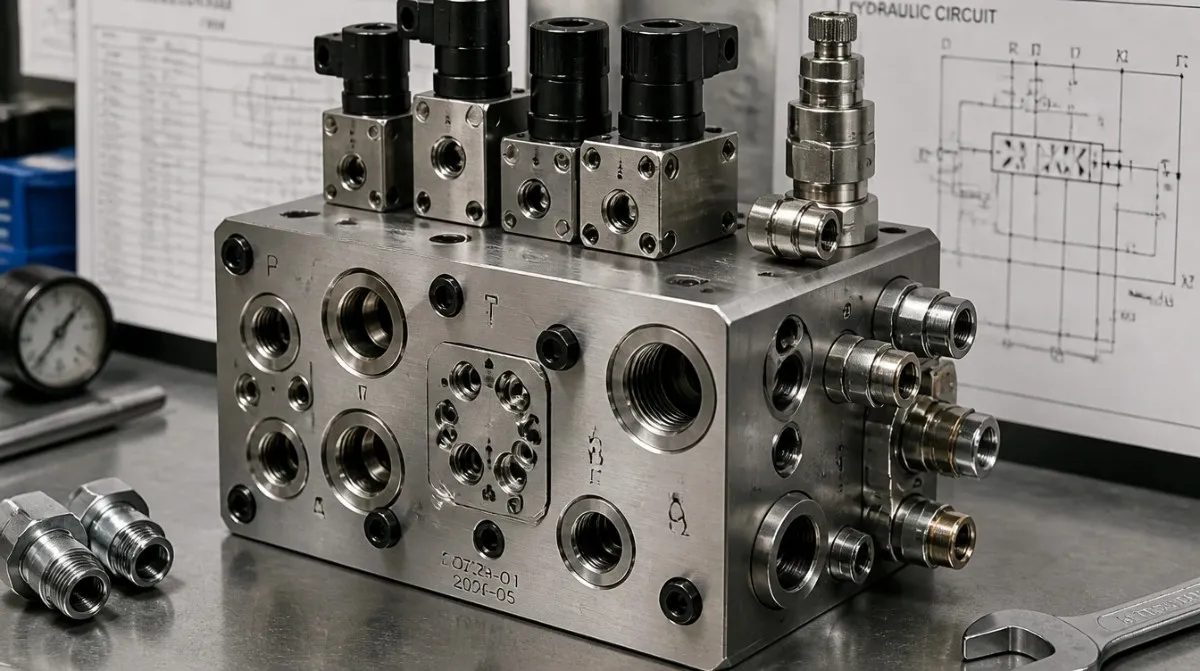
Stripping away the engineering jargon and Hydraulic Manifold Block Working is fairly straightforward. The block is a solid piece of bored steel — internal galleries connect inlet, work, and return ports in a pattern that matches your circuit logic. Valve-mounting faces are ground flat and finished to spec, then directional control valves bolt directly onto them.
When a solenoid energises, its spool shifts, oil travels through the internal gallery to the selected work port, and the return path opens simultaneously. Everything happens inside the block. No external piping, no threaded connections vibrating loose over time. That simplicity is precisely why manifold-based circuits are so much more dependable in demanding environments.
Pros & Cons
Here are some positives and negatives you should always know.
Pros
- Far fewer external fittings — some circuits go from 60+ connections to under 10
- Cleaner layout that's actually readable when something does go wrong
- Simplified compliance documentation for CE marking, BIS, or export requirements
- Scalable at design stage — extra stations designed in before machining, not bolted on after
Cons
- Higher initial cost than a piped alternative — this is real and worth acknowledging
- Internal drilling errors can't be easily corrected post-machining
- Specification must be final before machining starts — changes later are expensive
Who Should Buy This?
Straight answer — anyone running or supplying fluid-power systems at an industrial scale. More specifically:
- OEM machine builders working toward export markets — manifolds simplify CE documentation considerably
- Plant maintenance engineers replacing old piped circuits — the retrofit ROI is stronger than most people expect
- Hydraulic Manifold Block Dealer in India looking for a certified source with consistent batch quality and full test documentation
- Hydraulic Manifold Block Wholesaler in Ghaziabad supplying NCR, UP, and Haryana industrial clusters — local sourcing cuts lead times significantly
Things to Consider Before Buying
Here are some things to consider before buying.
- Circuit drawing review before machining — not after. Make sure the supplier's engineers actually check your schematic
- Material traceability — ask for mill certificates, especially for applications above 200 bar
- Thread and port standard — BSP, NPT, SAE, metric. State it clearly. Rework after the fact is both costly and time-consuming
- Realistic lead times — standard configurations typically ship in 7 to 14 working days; complex custom blocks take 3 to 5 weeks. Get it in writing
- What's actually included in the quote — test reports, assembly drawings, port plugs, surface protection. Clarify before, not after
- Hydraulic Manifolds at the best price in India is a fair goal, but price without test documentation is just cheap. Know the difference
Customer & User Experience
What buyers who've worked with serious Indian manufacturers consistently say: the pre-sales engineering engagement is what sets the good ones apart. A supplier who reviews your drawing, asks the right questions, flags a potential flow sizing issue before machining — that's worth more than a marginally lower unit price.
Common complaints I hear: insufficient documentation at quotation stage, and limited availability for very high-pressure configurations above 300 bar. If either of those matters for your application, raise it early. A reliable Hydraulic Manifold Supplier in Ghaziabad will provide hydrostatic test certificates, dimensional inspection reports, and material traceability as standard — not as paid add-ons.
About NTH
‘As an experienced company with a global reputation as a leader in providing advanced hydraulic solutions for modern manufacturing purposes, N.T. Associates has built its reputation through dedication to quality and innovation, which is reflected in our ability to supply reputable products and services in diverse industries, including those listed previously. Our many years of experience in providing specialty hydraulic hose pipes and precision-engineered components give us confidence that all our products will comply with the most stringent performance standards. N.T. Associates is a specialist in providing comprehensive solutions for hydraulic systems, including hydraulic pipe, hydraulic motor, hydraulic vane pump, hydraulic power pack, etc. Our experience comes from working with customers—a step that allows us to better determine what our customers need and to provide them with customized solutions to improve their everyday productivity and efficiency levels. If you are seeking hydraulic hose pipes, hydraulic motors, hydraulic vane pumps, hydraulic power packs, or any other related hydraulic equipment to support your operations and achieve your business goals, N.T. Associates can provide that solution.’
Conclusion
The manifold block is not a commodity purchase, even though it's sometimes treated like one. It sits at the centre of a hydraulic circuit, and every valve, actuator, and sensor downstream depends on it working exactly as designed — every cycle, for years. Getting that wrong isn't a minor procurement error. It shows up as downtime, warranty claims, and maintenance headaches.
There are genuinely strong manufacturers in India right now. Finding one means looking past the brochure — checking how their engineering team engages before the order, whether their test documentation is thorough, and whether their lead time promises hold up. That combination is what value actually looks like when you're sourcing a hydraulic manifold block for anything serious.
Need a trusted Hydraulic Manifold Supplier in Ghaziabad? Contact us today — bring your circuit drawing and we'll take it from there.
Dont just compare price. Ask every supplier for a hydrostatic test certificate, dimensional inspection report, and mill certificate. Missing any one of those is your answer right there.
Check valve-mounting faces and port plugs every 500–1,000 operating hours. Weeping at a valve face is almost always the O-ring, not the block itself.
Standard blocks suit simple two or three-station circuits fine. Anything beyond four stations or with specific flow requirements — go custom. The price gap is smaller than youd expect.
Ask for the hydrostatic test protocol 1.5 rated pressure, held duration, serial-matched reports. We test to industry standards with no paperwork behind it means nothing.
Thread inserts and plugged ports — usually yes. Structural gallery changes — no. Re-machining after the fact risks cross-contaminating flow paths and thinning pressure walls. The specification has to be right before the first chip falls.
Request a sample block with hydrostatic test certificate, dimensional inspection report, and material cert. Any credible Hydraulic Manifold Block in India supplier will hand you all three without hesitation. If they push back on any of those, that your answer.